
I am very proud to have compositions available for purchase from Keiser-Southern Ludwig-Masters, Per-Mus and C. Alan and JW Pepper My Score music publishers. Please see their websites or http://jwpepper.com or https://www.stantons.com/ for purchasing information.
Arrangements of Holiday, Pop, TV and movie arrangements for Concert Band, Jazz Band, Marching Band, Percussion Ensemble and other various Small Ensemble under copyright are also available from Sheet Music Plus or Sheet Music Direct.
56 Beginning Band Warm-Ups was conceived as a tool to help beginning band members learn and review. The warm-ups are divided into categories and designed to bounce around instead of being played one after another. Some warm-ups also employ repeated passages. These have been designed for two purposes. First, the teacher can model the performance for the students, and they, in turn, can echo it back; following that, individual students can be selected to play solo and have the entire band echo. This gives the teacher the opportunity to evaluate a student’s performance, even in the full band.

Concert & Contest: Grade 1
Alien Invasion from the Dark Planet; This beginning band work with Narrator will be a definite hit on your next concert. Telling the story of Aliens who attack your town, and how a group of student battle them, the music is coordinated with the narration to provide a fun and exciting composition.  (Keiser Southern/Ludwig-Masters). Grade 1.
Island Getaway: Take your beginning band on an Island Getaway vacation with this fun arrangement utilizing only the first 6 notes. (Southern Music) Grade 1.


Concerto for Jingling Bells Concerto for Jingling Bells was written with the Beginning Band in mind and features sleighbells, bells, and triangle as the “Jingling Instrument” as they are pitted against the woodwinds, brass and other percussion instruments. The shimmering sounds of the Concerto for Jingling Bells will add fun and magic to the first band concert. The sleighbell solo/soli part can be played by a school adminstrator, teacher, or any combination, provided you have enough sleighbells. I guarentee this will give the band program great PR!!!! Plus, they can better understand what it takes to be a beginning band musician.(coming in 2026 from Southern Music). Grade 1
Forgotten Echoes: Forgotten Echos is a fun “primal” piece for beginning band. Written in the Key of C minor, the piece will help establish brass range, although trumpet parts only extend to an A. Utilizing Clapping, and percussion effects, it is sure to be a hit for your ensemble and audience alike (Southern Music). Grade 1

Fanfare: Fanfare was writing for the Crestwood Intermediate School 6th grade band. Featuring only 6 notes, this work features a catchy melody to inspire beginning level players. The piece is written at a grade 1+ level, and is appropriate for end of first year instruction. (Keiser Southern/Ludwig-Masters) Grade 1 JW Pepper’s
Grandma Got Run Over by a Reindeer,” a novelty Christmas song written in 1979 by Randy Brooks, was originally performed by the duo Elmo and Patsy, who were actually Elmo Shropshire and his then-wife Pasty Trigg. The song has been adapted for grade 1.5 level band. The first clarinet parts extend over the break, while clarinet 2 remains complete below it. The ending includes the band speaking lines: “Merry Christmas” by the woodwinds, “HO HO HO” by the brass, and “Watch Out Grandma!” by all. The vocals should be clear and in rhythm as specified. After the speaking, a loud bass drum/wood/muted triangle hit is followed by a Cymbal crash, simulating Grandma’s impact. (Sheet Music Plus / Sheet Music Direct). Grade 1.5


The Haunted Granary: Haunted Granary is the musical story of a trip through a haunted house (or Granary). Complete with spooky music and vocal effects (Boo’s and Screams) this piece will delight beginning students. The Haunted Granary uses only 6 notes, except for the clarinets who also play a throat-tone Bb. (Keiser Southern/Ludwig-Masters) Grade 1. JW Pepper’s

March of the Woodland Patrol: is designed to introduce your band students to 6/8 (compound duple) meter and provide them with a fun and light march. Composed in the style of Grainger’s Children’s March: Over the Hills and Far Away, the piece begin simply with the call to muster by the trumpets and drums and a simple and quiet melody that increases in volume as we move through the mission, before folding back on itself and ending as it began, quietly, but with a surprise! March of the Woodland Patrol promises to be an educational and enjoyable piece for the students and audience alike. I recommend reading the story to your audience prior to playing the piece. You may also change the names of the kids to make it more personal for your ensemble. (coming from Southern Music in 2026). Grade 1.5-2.
“There were five of us, all 12 or 13 years old, and ready to begin the adventure of our lifetime. Maps…check, Rations…check, Weapons….check…now all we needed was the call to muster…..and with the sound of the drums and bugles we were off on our top secret mission. The sun hung high, warming the thick summer air as we crept through the woods, twigs snapping under our sneakers. Armed with sticks for rifles and faces smeared with mud, we moved in perfect formation. “Enemy base ahead,” Cole whispered, Izzy, our scout, peeked through the brush. “It’s over there in that grove of pine trees.” We marched on—until an ominous sound froze us. “Ambush!” Emerson dove behind a tree. We quietly sat for what felt like ours as the rustling sounds of the enemy army got closer. Would we ever see our homes again? But Robert had other ideas, he leaped out, raised his stick, and yelled, “Surrender!” Tension filled the air. Slowly we all rose to face our foes, —a family of squirrels, bolted from the bushes and ran past us. Laughter erupted. Cole said, “Wow, that was really scary, and now I’m hungry. I think we’ve accomplished our Mission haven’t we Troy?. Troy looked at the grove of pines in the distance for a moment and slowly nodded, “I think it’s Ice cream time!” he said. With victorious cheers, our intrepid Woodland Patrol marched home, our battle was won and the forest was again safe….at least until tomorrow. You never know what tomorrow will bring”.
Snow Day Rhapsody Growing up in the Midwest, the Winter months could be temperate or snowy. But nothing was more magical than getting up to see the newly fallen snow and checking the TV and Radio stations for those beautiful words “snow day.” Some children returned to bed; others planned their exciting day without school. Playing outside, making snowmen, snow forts, having snowball fights, and sledding were a great way to spend the day off. Snow Day Rhapsody draws upon the memories of the cold winds, the sounds of snowflakes in the air, and the fun kids had on their day off. Snow Day Rhapsody can feature your principal or superintendent narrating two short passages as shown below. (Available from JW Pepper.com). Grade 1

Time Bandits: The Time Bandits are at it again. Traveling through musical time stealing beats and creating instability in magnificent works. The world famous composer and music physicist Beathoven once proclaimed “For the music to flow correctly, it must have a steady pulse of four beats in a measure. This concept is as fundamental as the rising and setting of the sun that creates day and night. But the Time Bandits will do anything to destroy consistency in music, stealing beats here or there without a second thought. 4/4 time can be stealthily attacked becoming 3/4 time or it savagely slashed into 2/4 time. Not even the smallest 64th rest can survive! The destroyed beats disappear into the silence and desolation of the uncomposed music dimension. Occasionally however, the Time Bandits gets sloppy and drop a beat as they make their ninja-like escape. The orphaned beat quickly finds a new home in the composition. You might see and hear 5 beats in a measure. Overjoyed by being again included in the melody the orphaned beat shouts out making itself known to the notes around it! But beware, when the Time Bandits slip up, there always is a price to pay. In their anger and frustration they can unleash their most fearsome weapon, the Senza Tempus which annihilates music and beat, creating total silence. How long can it last? That depends on the band’s dedication. Can our adventurous young musicians work together so their composition can survive? It fight starts here and now……Assemble your instruments, wet those reeds, oil the valves, sit up tall, make final adjustments to the music stand, above all, watch your leader and keep tapping those toes to victory! Good luck Band Rangers [2026 OMEA JH Lg Group Class C]. (Keiser Southern/Ludwig-Masters). Grade 1.
The Rainmaker “The Rainmaker” is an aleatoric piece suitable for any type of musical ensemble. The overall effect becomes more powerful as more students participate. This engaging work features body percussion, with performers using their hands, legs, and feet to create the soundscape of a developing storm. The sequence includes:
- Making circles with two fingers on the opposite palm
- Tapping fingers into the palm
- Snapping fingers
- Patting legs
- Stomping feet
These gestures mimic the natural sounds of a rainstorm, beginning with the lightest drops and building to a dramatic downpour before gradually subsiding. At section G, students are instructed either to continue from step 6 or return to step 5, repeating the sequence with increased speed and intensity. This portion may include additional special effects, enhancing the storm’s climax. The piece concludes as it began—gently fading into silence as the “sun” emerges once again, Available from JW Pepper. Grade 1 but applicable for any age student
Concert & Contest: Grade 2

Proclamations: Dedicated to Mr. James Kirk former director of middle school bands at Nordonia Middle School band, Northfield, Ohio. This ABA style work is a great addition to the band literature. With a fanfare opening the piece begins with a spirited melody that evolves into a legato middle section before returning to the excitement of the beginning. Well written & employing a full percussion section. Available from Ludwig~Masters Music Publishers: Grade 2.5 – 3.
Concert & Contest: Grade 3
A Gaelic Blessing: Written in 1978 by John Rutter for four part Chorus, this arrangement has been scored for concert band. The short and powerful music is based “an old Gaelic rune”. The lyric use the words “deep peace” then references to peaceful things such as a “running wave,” “flowing air,” “quiet earth,” “shining stars,” “gentle night,” and “healing light.” Every attempt should be made to have the music flow. Grade 3 (Contact Brian Monroe for information).
American Colors March: Frank Panella, edited/arranged by Brian Monroe. American Colors March is a charming American march written in 1916 by Pennsylvania composer, Frank Patella. The opening presents powerful block chords before moving into the first strain, orchestrated for a woodwind choir, giving it a simple and delicate sound. The repeat of the strain (written out) includes the entire band. Care should be taken to keep the sound clear even though everyone is playing. The second strain contains more abrupt dynamic changes with varied textures or orchestration. Care must be taken to shape the phrases accordingly. The Key Change to Ab (measure 55) signals the arrival of the Trio at measure 59. Here, Panella uses the tune Columbia Gem of the Ocean. Columbia Gem of the Ocean was written around 1843 in Philadelphia, Pennsylvania. Of note is that the melody is performed once, then presented a second time (and optional 3rd time) with a virtuosic low brass obligato featuring scalar runs. The ending brings back the opening chords, which, this time, varied by dynamics before a delicate ending. Other composers, including Charles Ives in his Second Symphony and Piano Sonata #2 and Meredith Wilson in The Music Man, also quoted Columbia Gem of the Ocean numerous times. It was even heard in the 1930s Popeye cartoons. (Southern Music). Grade 3.
American Spirit: Chip Davis/ Arr. Brian L. Monroe. American Spirit is an album released on American Gramaphone in 2003 as a collaboration between Mannheim Steamroller and country musician C. W. McCall. The composition American Spirit was composed by Chip Davis and scored for concert band with Narrator(s) with optional kids narration at the end by Brian Monroe. Work also contains extended percussion effects, and whistling. (contact Brian Monroe for performance information). Grade 3
Loch Lomond: The song Loch Lomond first appeared in “Vocal Melodies of Scotland” published in the 1840’s. With no attributed composer, it remains a mystery who wrote the melody. Loch Lomond is a famous freshwater Scottish loch (lake) between the lowlands of central Scotland and the Highlands. The lake is about 23 miles long and 5 miles wide. This arrangement for Concert Band is Available from (Keiser Southern). Grade 2.5 – 3
March: On the Air: Frederick Jewell. In the early 1920’s only 1% of the population of the United States owned a radio. Over the next 15 years that number rose to over 75%. Frederick Jewell, was born on May 28th, 1875 in Green County Indiana, about 35 miles from Bloomington. From an early age Jewell showed a talent in music playing cornet, violin, and euphonium. His talents took him on the road performing and directing various bands including Circus Bands. After several years on the road he returned to Indiana and founded his own community band which was featured on radio programs. March: On the Air was composed during this time. (coming in 2026 from Keiser Southern) for details.

Seaside Sunrise: There is something magical about the ocean and watching the sunrise over the water. Beginning with the stillness of the early morning, before the first light breaks, there is a peacefulness that one feels as the waves lazily lap against the shore. Slowly, a light appears dimly on the eastern horizon, like looking down a long hallway at a fresh struct match. Brighter and brighter it grows as the sky changes from black to shades of blue, pink, purple, orange, and red. Daybreak has occurred! The sun fills the azure-colored sky and touches us with its warmth. From this time until dusk there is a never-ending blur of excitement, fun, and of course memories that will remain with us forever. Dedicated to Debbie Wiandt and the Crestwood Middle School 8th Grade Band in memory of Steve Wiandt, the piece features fragments of the hymn “Because He Lives” throughout. Grade 3 $50.00  Contact Brian Monroe for information
Pahson Trombone: Henry Fillmore, editied Brian Monroe. Returning from 1917 comes this Henry Fillmore March featuring the Trombones and Glissandos. Billed as Lasus Trombone’s “Ole Man”. The slow and stately strut of this march is contrasted with a ragtime style Trio featuring woodwinds and xylophone before returning to the slow, lumbering original melody. (Available from JW Pepper.com). Grade 3.
Concert & Contest: Grade 4
Avalanche! in the Bleak Midwinter is a seven movement theatrical composition and study in orchestration, texture and contrasts. Various percussion instruments are used to provide different colors. The percussionists move through the audience and two percussionists are positioned behind the audience to create a surround sound effect. Lighting effects, such as blackouts, dimly lit scenes, colored lighting and even a “disco ball” effect all help to visually depict the story. Newly Revised! Grade 4+ (JW Pepper.com) 🎬 Watch the Video of the BYU Symphonic Band
I. Setting and a Snowstorm The work is set in a small mountain village. Each year after the first heavy snowfall, one man must climb to the peak of the mountain to pray for an easy winter. The first movement describes the village with its church bells ringing, echoing against the mountains and the peaceful villagers, represented by the Hymn “In the Bleak Midwinter”. The crotales introduce the snow storm motif which carries through the entire ensemble. The storm becomes very strong as represented by the full ensemble sections. It then clears, fading into the second movement.
II. Climbers Song The second movement, Climbers Song depicts the steadfast pace of the man as he climbs the mountain. As he ascends, the energy grows until he reaches the top. The last few steps are energized with the feeling of accomplishment. With this he relaxes and thinks about his journey and his task still to come. A faint flutter of snowflakes still dance in the air. His reflection is represented by the brief hymn quote.
III Where the Peeks Scrape the Sky: The man stands at the peak and looks out over the mountain range and down to his village below. The peaks seem to scrape the sky as the wind blows the clouds overhead. The cold and splendid beauty of this place is witnessed through the shimmering woodwinds and percussion.
IV & V Dispersion! & Avalanche The man finishes his ceremony and begins to descend when suddenly when the ground begins to shake. At first there is no movement then slowly the shattering effect is felt as an Avalanche Begins. The rumble begins and leads to the Avalanche theme. It is followed by the avalanche’s run out and the man’s entrapment. Clashing and smashing percussion sounds of the avalanche serve to reintroduce the hymn, this time dissonantly harmonized representing the destructive forces of nature. The mans is wiped from the mountain and buried.
VI Aftermath, Reflections, Survival Unconsciousness fades as he realizes his situation. Buried, but alive, the man reflects upon what has happened. His faith calms him with the fact he has accomplished his task and gives him a sense of peace. Undaunted he attempts to free himself. This is represented by the use of a new melody, based on In the Bleak Mid Winter which is repeated and varied. Each repetition adds more textures & colors as our hero conquers death. With the final exalted burst of color and energy, the man is free. He has conquered the mountain.
VII Epilogue The man returns home and the work ends much as it began, with the snow falling upon the village the hint of a choir singing upon the wind and snow flakes dancing in the air.
Cantique De Noel: This Christmas Hymn, also known as O Holy Night, features piano and Woodwind, Brass and Percussion Ensemble settings before combining the to create the full ensemble texture: Grade 4 . (Contact Brian Monroe for information)
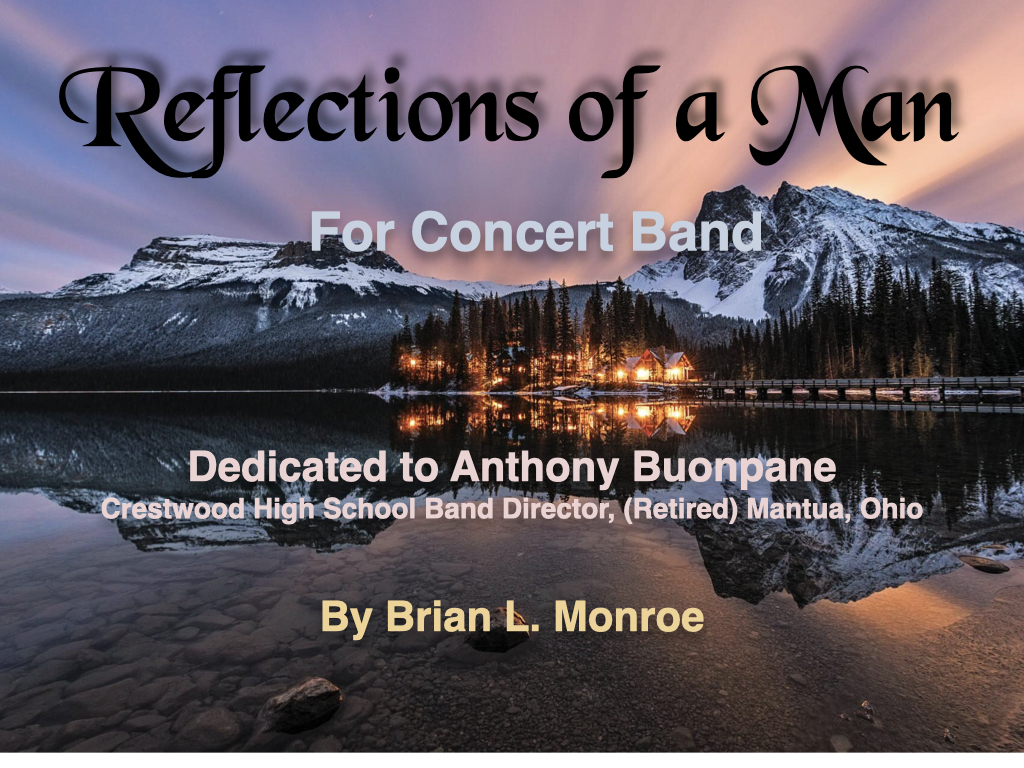
Reflections of A Man is dedicated to Legendary Ohio Band Director Anthony Buonpane. Reflections of a man composition in Intro ABA Coda form. Beginning with a clarinet solo, it moves into a playful melody before transforming into a lush and lyrical middle section featuring flute, horn, trumpet and oboe. The piece concludes by returning to the playful melody. The coda returns to the opening clarinet solo, leaving the listener reflecting on the piece.Grade 4. . Contact Brian Monroe for information
Still, Still, Still, Silent Night: This work features settings of Still, Still, Still, and Silent Night. Based on a well-known choral version by Cindy Berry, this band setting features the colors of the modern concert band, complete with full percussion writing in mallet percussion. Grade 4 * . Contact Brian Monroe for information
ARRANGEMENTS FOR BAND & SOLOISTS
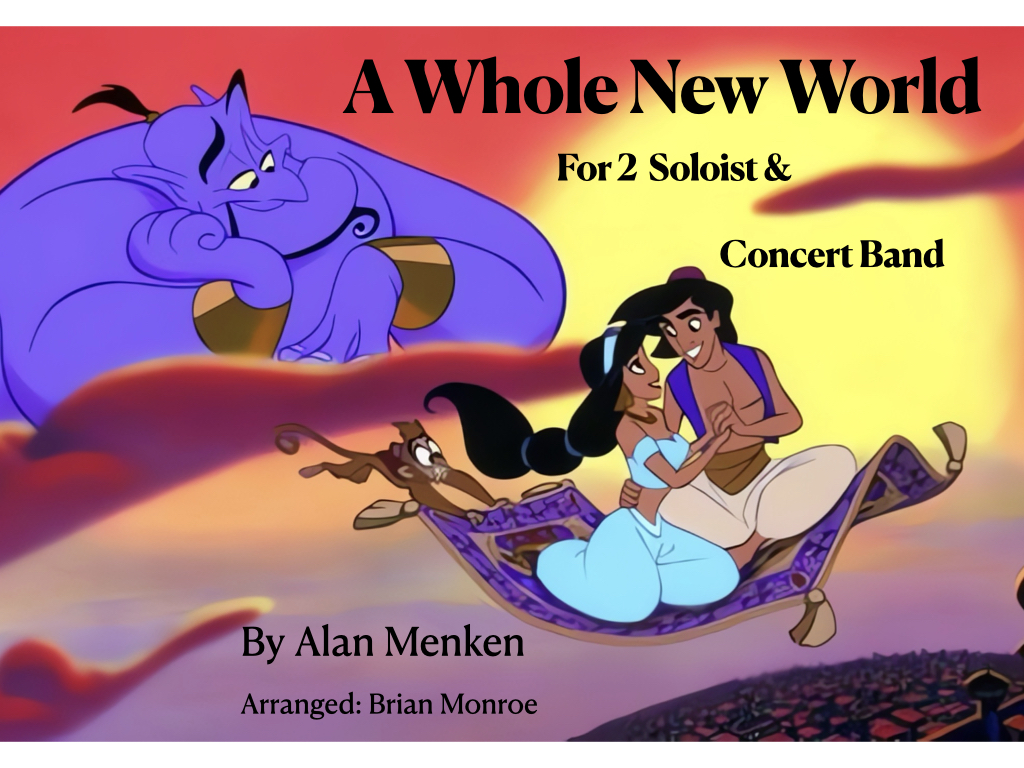
A Whold New World from Disney’s Aladdin: “A Whole New World” is still one of Disney’s most loved love songs. The music by Menkin and Tim Rice creates magic which eleveates the visual! elevates A Whole New World has been scored For Vocal Duet and Concert Band. Ranges are Grade 3 while demands of the Flute 1 make it a Grade 4 (Sheet Music Plus/Sheet Music Direct).
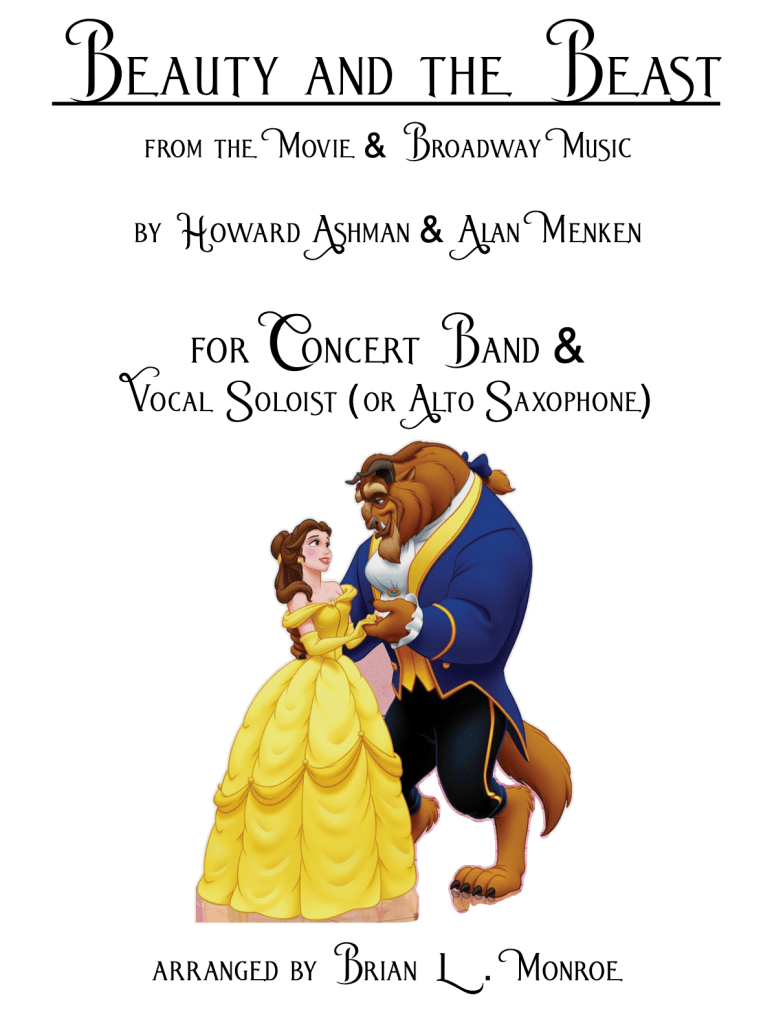
Beauty and the Beast: This arrangement of Beauty and the Beast, a nod to the Disney hit featuring Angela Lansbury as Mrs. Potts, is adaptable to different performance scenarios. It’s been arranged for a Grade 4 Concert Band with options for Vocal Soloist or Alto Saxophone Solos. If a vocal soloist is used, the 1st Alto Saxophone part can be used to double the melody or eliminated, allowing for a flexible and personalized performance. Grade 4 (Sheet Music Plus, Sheet Music Direct.
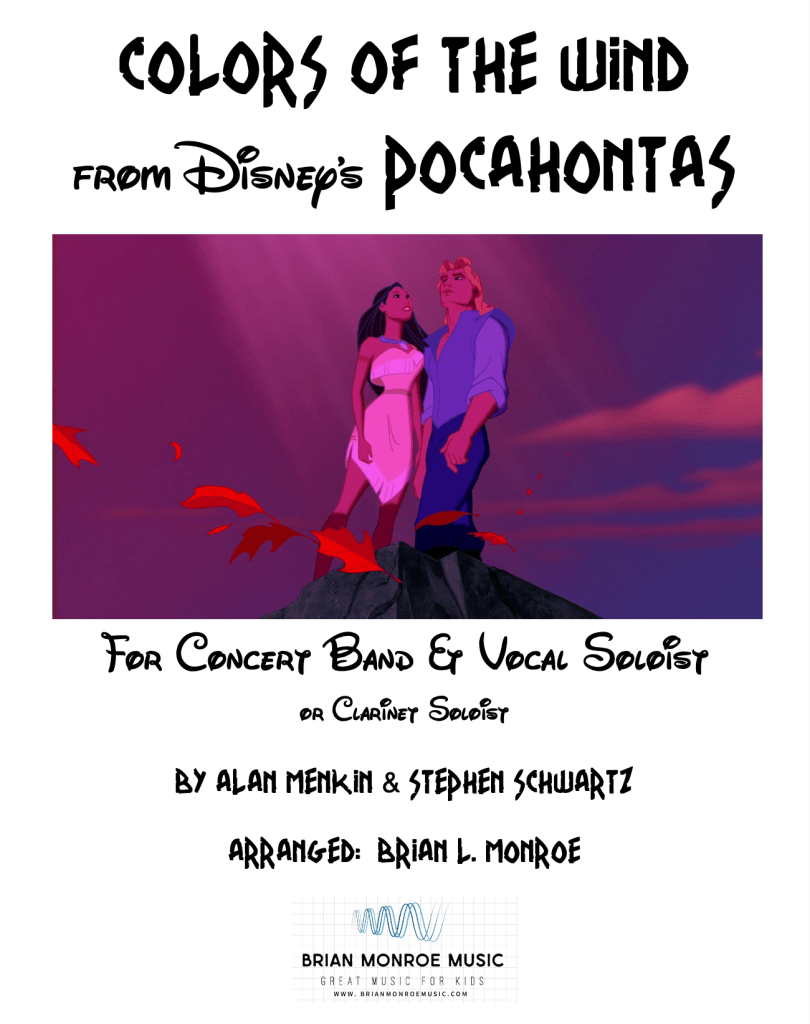
Colors of the Wind: this arrangement of Colors of the Wind, from Disney’s Pocahontas, is adaptable to different performance scenarios. It’s been arranged for a Grade 4 Concert Band with options for Vocal Soloist or Alto Saxophone Solos. If a vocal soloist is used, the Clarinet 1 part can be used to double the melody or eliminated, allowing for a flexible and personalized performance. Beginning in the key of Eb, it quickly modulates to C major. (Sheet Music Plus, Sheet Music Direct). Grade 4 .
For Good: From the hit Broadway musical, Wicked comes this fantastic arrangement of the Duet Ballad “For Good”. for vocalists and concert band. Feature your own Glinda and Elphba in this work. Scored in the keys of Eb and Gb the work will be a hit at any concert. The Piano part is optional adding more depth to the arrangement: (Sheet Music Plus, Sheet Music Direct). Grade 4.
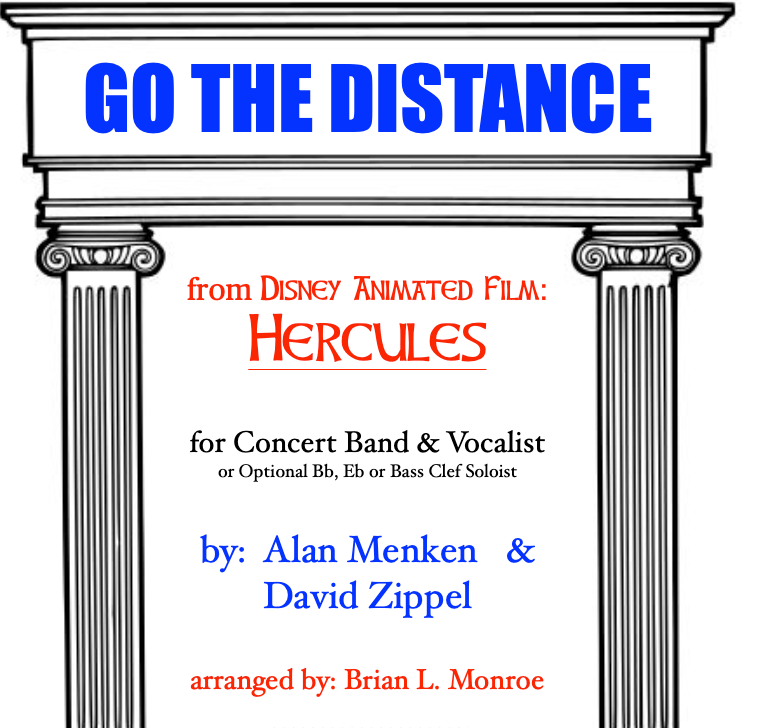
“Go the Distance” is a song from the 1997 Disney animated feature film Hercules. Composed by Alan Menken with lyrics by David Zippel, it one of seven songs in the movie. Upon its release by Michael Bolton, it achieved popularity as a pop hit. The song received nominations for the Academy Award for Best Original Song and the Golden Globe Award for Best Original Song.
In “Go the Distance,” Hercules, a young man with extraordinary strength, expresses his deep yearning to find where he truly belongs. Though raised by mortal parents, he feels out of place in the human world and is determined to discover the truth about his origins. The song marks a pivotal moment of self-discovery and resolve, as Hercules sets out on a journey to prove himself a true hero and reclaim his place among the gods on Mount Olympus.
Emotionally uplifting and inspirational, the song captures Hercules’ desire for purpose, identity, and acceptance. Its powerful lyrics and sweeping melody embody the central themes of the film—perseverance, self-belief, and the pursuit of greatness
This arrangement of “Go the Distance” has been created by Brian Monroe for a concert band and a vocal soloist. The arrangement is in the key of Ab with a modulation to F. The vocal range spans the interval of an octave and a fifth (Ab to Eb). Solo parts are also included for Bb Instrument, Eb Instrument and Bass Clef instrument. It is grade 3-4 in difficulty.
God Bless America Finale: God Bless America has been a long-time patriotic favorite for almost 90 years. Scored for Concert Band (with audience signing) and a optional Trumpet Soloist, this short arrangement will make a fantastic finale for your concert. Grade 3-4., trumpet soloist Grade 4+
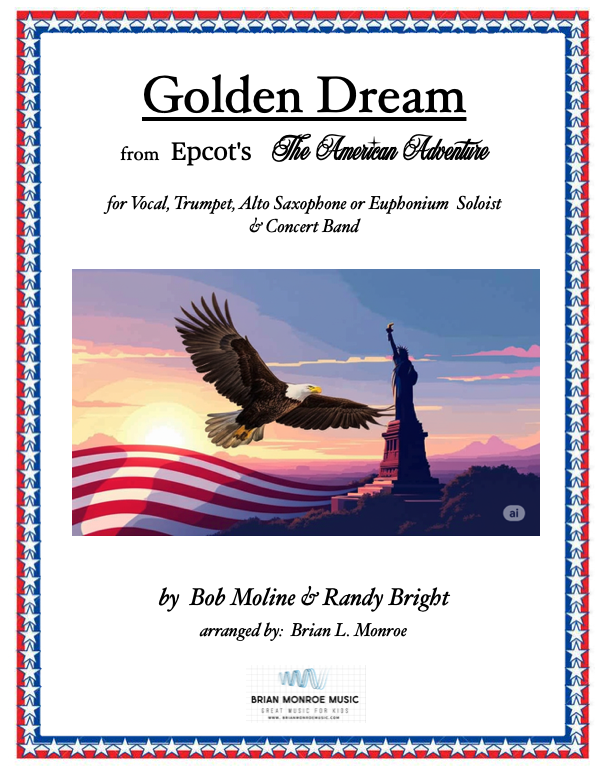
Golden Dream: a captivating musical composition, is featured in the Epcot attraction “The American Adventure” and at Disneyland’s “Moments with Mr. Lincoln.” Composed by Robert Moline, with lyrics, by Randy Bright, Golden Dream introduced during the opening of “American Adventure” in 1982. This powerful and uplifting piece eloquently embodies the American spirit and the nation’s historical trajectory. Since its inception in 1982, “Golden Dream” has undergone various iterations, with my arrangement drawing inspiration from the 1990s setting. Written for concert band and soloist in the key of C major, the piece can be performed by a vocal soloist. Alternate solo parts have also been included for Trumpet, Alto Saxophone, or Euphonium (bass clef). The vocal range extends slightly beyond an octave, spanning from D to F concert pitch. The work is scored for students of grades 3.5 to 4. The middle of the piece contains audio execrates from John F. Kennedy’s inauguration speech, Martin Luther King’s “I Have a Dream” speech and the 1969 Apollo 11 Moon landing. An MP3 of the audio can be downloaded from my webpage (www.brianmonroemusic.com). I hope you enjoy Golden Dream! The Narration mp3 track can be downloaded here: Narration Track (Available from Sheet Music Plus and Sheet Music Direct).
I’ll Make A Man Out Of You: Male Vocalist w/band
I’ll Make a Man Out of You: was written by composer Matthew Wilder and lyricist David Zippel for Walt Disney Pictures’ animated film Mulan (1998). It was performed by American singer Donny Osmond as the singing voice of Captain Li Shang. The original orchestration was written for Rock band with additional strings and trumpet. This arrangement by Brian L. Monroe uses the full forces of the modern concert band with a male vocal soloist to recreate the movie soundtrack. It can also be performed with a solo Trombone or Euphonium playing the Vocal Part. Vocal range is: C below middle to C to Eb just above middle C. (Available from Sheet Music Direct & Sheet Music Plus) Grade 3.5 – 4. .

Part of Your World: from Little Mermaid: “The Little Mermaid” is still one of Disney’s most loved movies. The music by Menkin and Ashman creates magic which eleveates the visual! elevates Part of Your World has been scored For Vocal Soloist and Concert Band. Grade 3 (Sheet Music Plus/Sheet Music Direct).
Popular: Popular” was written by the composer Stephen Schwartz for the first act of the 2003 musical Wicked. It is sung by the character Glinda and is considered the character’s definitive song, while also including brief dialogue interludes by Elphaba. While writing the song, Schwartz imagined one of “those cheerleaders” — “She was the most popular girl at school, and she always went out with the captain of the football team. She was always the homecoming queen, blonde with a perky nose – the whole thing.”
In “Popular”, Glinda attempts to get Elphaba, the future Wicked Witch of the West, to conform to the accepted ideas of beauty and popularity as a means of establishing their newfound friendship. Enjoy! Vocal Range: A below middle C to C above middle C. (Sheet Music Plus, Sheet Music Direct). Grade 3.5-4.
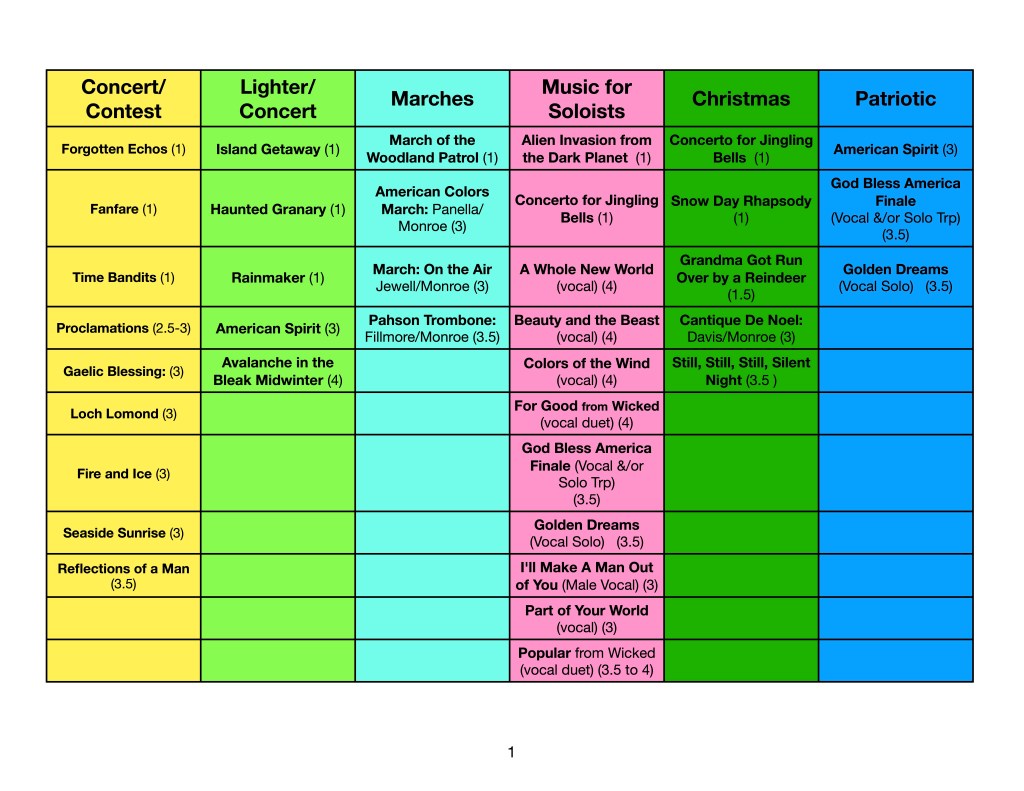
MUSIC USE GUIDE


 BMM
BMM 